What It Actually Takes to Get GSA Certified
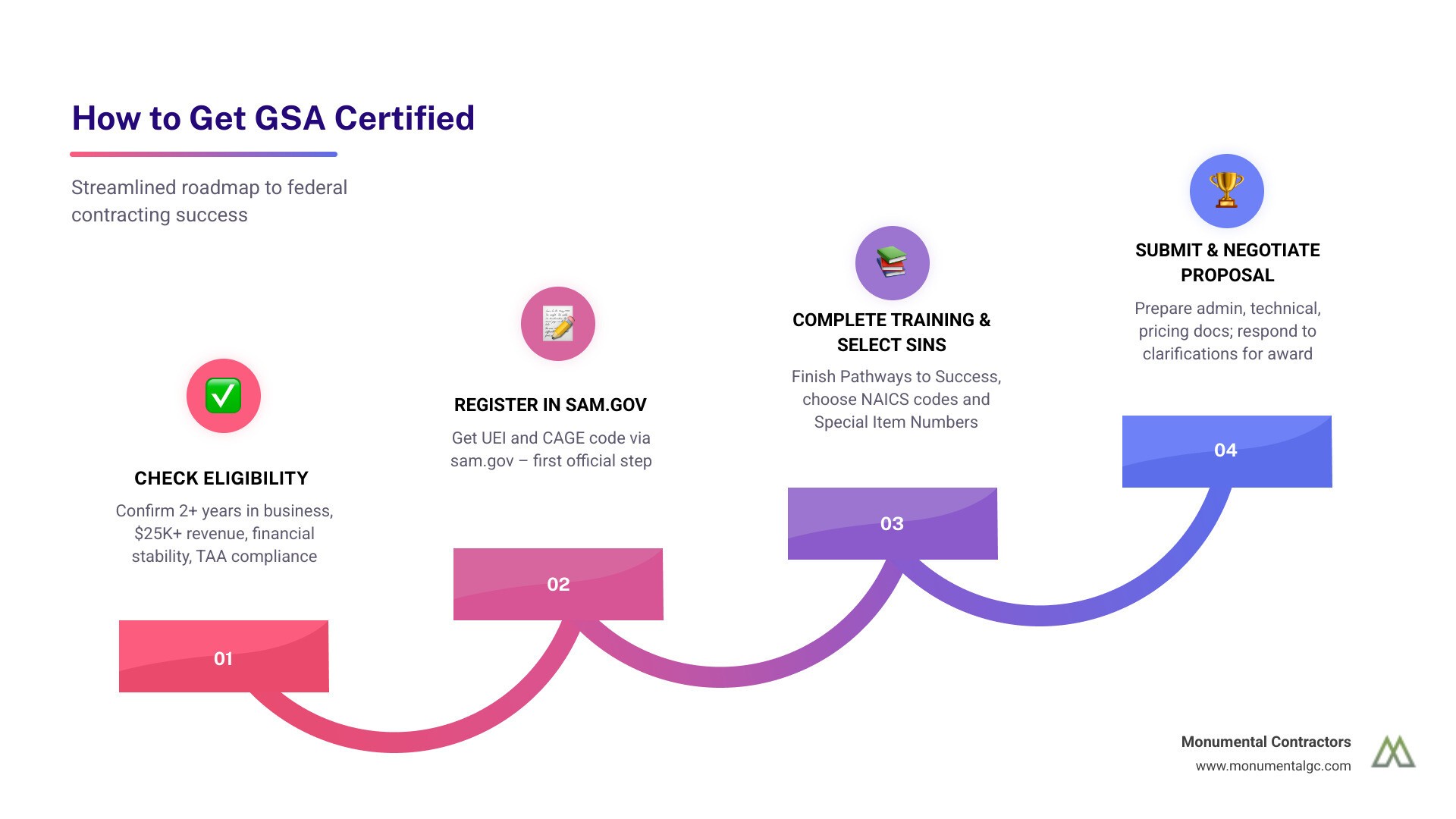
How to get GSA certified comes down to six core steps: check your eligibility, register in SAM.gov, complete required training, select your Special Item Numbers (SINs), submit your proposal, and navigate the award process.
Here's a quick overview:
Check eligibility - Be in business at least 2 years with $25,000+ in annual revenue
Register in SAM.gov - Obtain your Unique Entity Identifier (UEI) and CAGE code
Complete Pathways to Success training - Mandatory for all applicants
Select your SINs and NAICS codes - Match your offerings to federal buyer categories
Submit your MAS proposal - Cover administrative, technical, and pricing sections
Negotiate and receive award - Respond to clarifications, finalize terms
The process takes anywhere from 60 days to over a year. Starting early matters — applications are reviewed in the order they arrive.
If you manage facilities, own commercial property, or run a contracting business in the DMV area, a GSA Multiple Award Schedule (MAS) contract can open the door to billions in federal spending. The GSA Schedules program alone accounts for roughly 10% of all federal procurement, and the average GSA contractor brings in more than $1.6 million in sales through the program.
But here's the reality: the process is not a simple form. It's a full proposal in response to an open-ended government solicitation — and roughly only 15% of applicants succeed on the first try. Small errors in paperwork are one of the most common reasons for delays or denials.
The good news? With the right roadmap, you can get the process started today — in less than an hour.
The Value of the GSA Multiple Award Schedule (MAS)
“GSA certified” is the phrase people use, but what we’re usually talking about is holding a GSA Multiple Award Schedule (MAS) contract. That contract makes your products and services easier for federal buyers to purchase because key terms are pre-negotiated (think: pricing structure, basic contract clauses, and standard ordering rules).
Why it matters for businesses in Maryland, Virginia, and DC:
Access to federal buying channels that many agencies prefer because it’s a streamlined, compliant vehicle
Long runway: MAS contracts can run up to 20 years (an initial 5-year period plus three potential 5-year extensions)
Less “cold start” selling: buyers often filter vendors by Schedule availability
Small business-friendly: about 80% of GSA Schedule contractors are small businesses
Meaningful upside: average sales per GSA contractor exceed $1.6 million (sales vary widely, but the demand is real)
For contractors and facility service providers like us at Monumental Contractors, MAS can be especially useful when agencies need ongoing work like building maintenance, staffing, repairs, or renovations across a portfolio.
If you want the rulebook behind government buying (bedtime reading for the truly brave), it lives in the Federal Acquisition Regulation and related policy libraries: Federal acquisition regulations

Leveraging Small Business Certifications
A MAS contract is one big lever. Small business certifications can be a second lever that helps you compete for set-asides or preference programs (depending on the opportunity).
At a high level:
Some statuses are self-represented in SAM.gov (for example, “small business” and “small disadvantaged business” are commonly self-certified during registration).
Other categories require formal certification through SBA or VA pathways.
A practical first move is to confirm whether you qualify as a small business under SBA size standards:
If you do qualify, we recommend beginning any certification process early (it can take weeks to months), especially if you plan to pursue set-aside opportunities later.
Step-by-Step: How to Get GSA Certified Starting Today
If your goal is “start GSA certification in less than an hour,” we’re not promising you’ll be done in an hour. We’re promising you can start correctly in an hour by getting the foundation in place.
Here’s the most efficient order of operations we use when mapping the process.
Create (or confirm) your entity record in SAM
Get your UEI (and CAGE code as part of SAM registration for many entities)
Confirm eligibility for MAS
Knock out required training (Pathways + Readiness Assessment)
Narrow your SIN/NAICS strategy (don’t over-scope your offer)
Start your document collection for admin/technical/pricing
Your SAM step is non-negotiable:
Minimum Eligibility: Do You Qualify to Get GSA Certified?
Before you put serious effort into proposal writing, it’s worth doing a reality check. GSA evaluates whether you’re a responsible contractor with financial and operational stability.
Common baseline expectations referenced in GSA guidance and industry practice include:
At least 2 years in business
Average annual gross revenue of at least $25,000 (GSA highlights this threshold in its contract requirements guidance)
Financial stability (you should be able to support performance and survive normal payment cycles)
Past performance / references showing you can successfully deliver what you’re offering
Compliance, including Trade Agreements Act (TAA) for applicable products
TAA is often where companies accidentally step on a rake. If you sell products (or resell equipment), you need to understand the rule:
In plain language: many items sold through a GSA Schedule must be made (or “substantially transformed”) in the U.S. or in a designated country. If not, they may be prohibited on Schedule.
Fast-Tracking the Process: How to Get GSA Certified as a Startup
If you don’t have the typical two-year history, you’re not automatically out.
GSA has a path aimed at helping certain newer companies qualify using alternative evidence (especially relevant in some categories like IT). The program is commonly referred to as the Startup Springboard.
Even if you’re a startup, you’ll still need to show:
you’re commercially active,
you can perform,
you can support the contract financially,
and you can comply (including TAA where relevant).
Also, regardless of company age, GSA expects offerors to complete readiness preparation:
For service providers in the DMV (like construction-related services, facilities support, janitorial, staffing, etc.), the bigger “startup” challenge is usually past performance. If you don’t have government CPARS, you’ll likely need strong commercial references that map directly to the SIN scope you’re proposing.
Essential Prerequisites and Mandatory Training
This section is where a lot of “we’ll do it later” turns into “why is our offer getting kicked back?”
To be truly ready to submit, you need four foundational pieces:
An active entity registration in SAM (with UEI)
Clear NAICS codes aligned to what you sell
A FAS ID (for system access like eOffer/eMod in the broader process)
Completed mandatory GSA training steps
NAICS is the easy one to start:
A few practical tips:
You can register more than one NAICS code. Choose codes that truthfully reflect what you do.
Keep a record of what you chose and why. You’ll use it later when you align SINs and describe scope.
And yes: training is required. The big “must do” is Pathways.
Pathways helps you understand what the MAS program is, what GSA evaluates, and whether a Schedule contract fits your goals. It’s also one of those items GSA expects you to have done before you show up with a proposal.
Identifying Your Special Item Number (SIN)
If SAM registration is your “license to enter the building,” SIN selection is your “tell us what room you belong in.”
SINs (Special Item Numbers) are how GSA organizes what you sell. Buyers search by SIN, and GSA evaluates your offer against the SIN’s scope and requirements.
Your best starting points:
Review the MAS program structure and SIN list: Multiple Award Schedule
Cross-check vendors and scopes using GSA eLibrary (helpful for sanity-checking whether your services really belong under a SIN)
What “good SIN selection” looks like:
You pick SINs that match your real offerings (not your future aspirations)
Your past performance references align to those SINs
Your pricing narrative supports those SINs (labor categories, SOWs, etc.)
What “bad SIN selection” looks like:
You pick too many SINs “just in case”
Your references don’t support the scope
You end up rewriting your offer multiple times during clarifications
SIN vs. NAICS: A simple comparison table
Topic | SIN (Special Item Number) | NAICS Code |
|---|---|---|
Purpose | Organizes what you sell under MAS for buyer search and contract scope | Classifies your business industry for government reporting and opportunity matching |
Who uses it | GSA contracting and federal buyers | Census/SAM/SBA and agencies |
Where you pick it | In your MAS offer strategy | In SAM registration (you can choose multiple) |
Common pitfall | Over-scoping and mismatching past performance | Picking NAICS that don’t reflect actual operations |
If we’re building a MAS offer strategy for work around Maryland, Northern Virginia, and DC, we keep SINs focused on what we can deliver reliably across the region (and what we can support with documented experience).
Developing Your Administrative, Technical, and Pricing Proposal
This is the part people underestimate. A MAS “application” is really a proposal package with three major components:
Administrative
Technical
Pricing
You’ll be uploading files, completing required representations, and proving you’re a responsible offeror with fair and reasonable pricing.
Administrative section (what you’re proving)
Think “we are a legitimate business and we’re in good standing.”
Common administrative items include:
Proof your SAM registration is active (with UEI)
Basic corporate information (legal name consistency matters a lot)
Required representations and certifications (many are handled in SAM, but must be current and accurate)
Financial documentation supporting responsibility (commonly P&L, balance sheet, or other support depending on your situation)
One of the most common pitfalls we see in the admin bucket: inconsistencies.
Different legal names across documents
Old addresses on bank letters
SAM profile not matching the offer
Tiny errors can cause long delays because you’ll get clarification requests and the review clock effectively slows down.
Technical section (what you’re proving)
Think “we can actually do the work.”
Typical technical components include:
Corporate experience narratives aligned to SIN scope
Past performance references (commercial and/or government)
Quality control approach
For services: labor category descriptions, minimum qualifications, and how your team maps to the work
If you’ve worked with the government before, GSA may consider CPARS history. If not, strong commercial references can still work if they’re relevant and verifiable.
Pricing section (what you’re proving)
Think “our pricing is fair and reasonable compared to the market.”
This is where you’ll commonly see:
Commercial price lists (or rate cards)
Discounting practices (how you discount and to whom)
Pricing support like invoices and rationale (GSA wants to understand your real-world pricing)
Considerations like the Industrial Funding Fee (IFF) that applies to Schedule sales
In many offers, this is also where Commercial Sales Practices (CSP) disclosures come up (unless an alternative approach applies). The goal is to show the government isn’t getting a worse deal than your comparable commercial customers, and to establish a defensible pricing relationship.
Navigating Negotiations and Award
After submission, your offer typically goes through phases:
Initial review by the assigned contracting office
Clarifications (GSA asks questions; you respond with edits/support)
Negotiations (pricing, discounts, terms)
Final proposal revision and award decision
GSA explains the basic flow here:
What negotiations often focus on:
Your proposed discounts (including any volume/quantity discount logic)
Whether your price support truly matches what you claim is “commercial”
Confirming you understand the contract terms and can comply after award
Our advice: respond quickly, clearly, and with organized attachments. Fast responses don’t just look good; they reduce the risk your offer stalls out in the “back-and-forth forever” zone.
Frequently Asked Questions about GSA Certification
How long does the GSA approval process typically take?
It varies widely.
From our research and common experience:
Some offers can move in as little as 60 days
Many take months
Backlogs and clarification cycles can push it to over a year (a 12+ month review is not unheard of)
There’s also an acceleration program in certain categories (often discussed as FASt Lane for IT). Even then, speed depends heavily on:
how complete your submission is,
how quickly you answer clarifications,
and whether your pricing support is clean and consistent.
Common timeline killers:
Incomplete SAM registration or expired SAM
Misaligned SIN selection (forces technical rewrites)
Weak pricing support (forces renegotiation and resubmission)
TAA uncertainty for products (forces sourcing changes)
What are the ongoing responsibilities after receiving a contract?
Getting awarded is the start of the relationship, not the finish line.
Common ongoing responsibilities include:
Maintain SAM registration (renew and keep details current)
Sales reporting on the required cadence (varies by contract requirements)
Pay the Industrial Funding Fee (IFF) on reported sales
Accept Mass Modifications when GSA updates standard terms (often required within a set window)
Keep your pricelist/catalog current (and process modifications when things change)
Stay compliant with sourcing rules (including TAA, where applicable)
If you sell products online to agencies, you’ll also want to understand the ecosystem of buyer-facing tools like:
For service contractors, “catalog upkeep” often means keeping labor categories, rates, and SIN scope accurate and updated through the proper modification process when your business evolves.
Should I hire a consultant for my GSA application?
Sometimes yes, sometimes no.
We don’t believe everyone must hire outside help. But we do believe everyone should be honest about internal capacity. A MAS offer requires:
careful document control,
comfort with federal contracting language,
pricing strategy and supporting evidence,
and project management discipline (because delays often come from slow responses).
When outside support tends to make sense:
You’re short on bandwidth and can’t afford months of stop-and-start progress
Your pricing structure is complex (many labor categories, many products, many discount tiers)
You sell products with complicated country-of-origin sourcing (TAA risk)
You’ve been rejected or delayed before and want to fix the root cause
When self-submission can work well:
You have clean financials and organized documentation
Your offering is narrow and clearly matches 1-2 SINs
You have solid, verifiable past performance
You can respond quickly during clarifications/negotiations
Either way, the biggest theme is this: clerical errors are expensive. A small mismatch can create a long delay. If your team is detail-oriented, that’s a strong sign you can run it internally.
Conclusion
A GSA MAS contract isn’t magic. It’s a structured way to sell to government buyers with pre-negotiated terms, and it can be a major growth lever for companies that can meet the requirements and stay compliant.
If you’re researching how to get GSA certified, the fastest win is to start correctly:
confirm eligibility,
register in SAM.gov,
complete Pathways to Success and the Readiness Assessment,
choose the right SINs and NAICS codes,
and begin building a clean, well-supported administrative, technical, and pricing proposal.
At Monumental Contractors, we serve homeowners, commercial property owners, and organizations across Maryland, Virginia, and DC, and we understand how important it is to have a contracting partner who can scale from small projects to complex facilities work.
If you want to learn more about how we support public-sector and commercial clients through our Commercial & Government Solutions pillar: